While no sea turtle season could ever be considered dull, this season proved to be full of surprises. We documented more rare species nesting on the islands than ever before. Sanibel’s nesting season started with the nesting of a rare Kemp’s ridley (Lepidochelys kempii) and continued with a total of seven green turtle (Chelonia mydas) nests. Captiva even got in on the fun with the first green nest documented on the island since 2007. In all, Sanibel had a total of 277 nests and 443 false crawls and Captiva had 75 nests and 54 false crawls.
 |
| A green turtle nest laid on Sanibel. |
2011 was the sixth best year for nesting since 1996 on the islands. The overall hatch success (the percentage of eggs to hatch) was 67.7% for Sanibel and 70.4% for Captiva. The emergence success (the percentage of a nest’s hatchlings to leave the nest) was 59.7% for Sanibel and 61.9% for Captiva. This is compared to last year’s hatch success of 65.75% and emergence success of 60.3% on Sanibel and 57.34% on 45.8% respectively on Captiva. Overall, the islands produced approximately 25,411 eggs and approximately 15,786 hatchlings reached the Gulf.
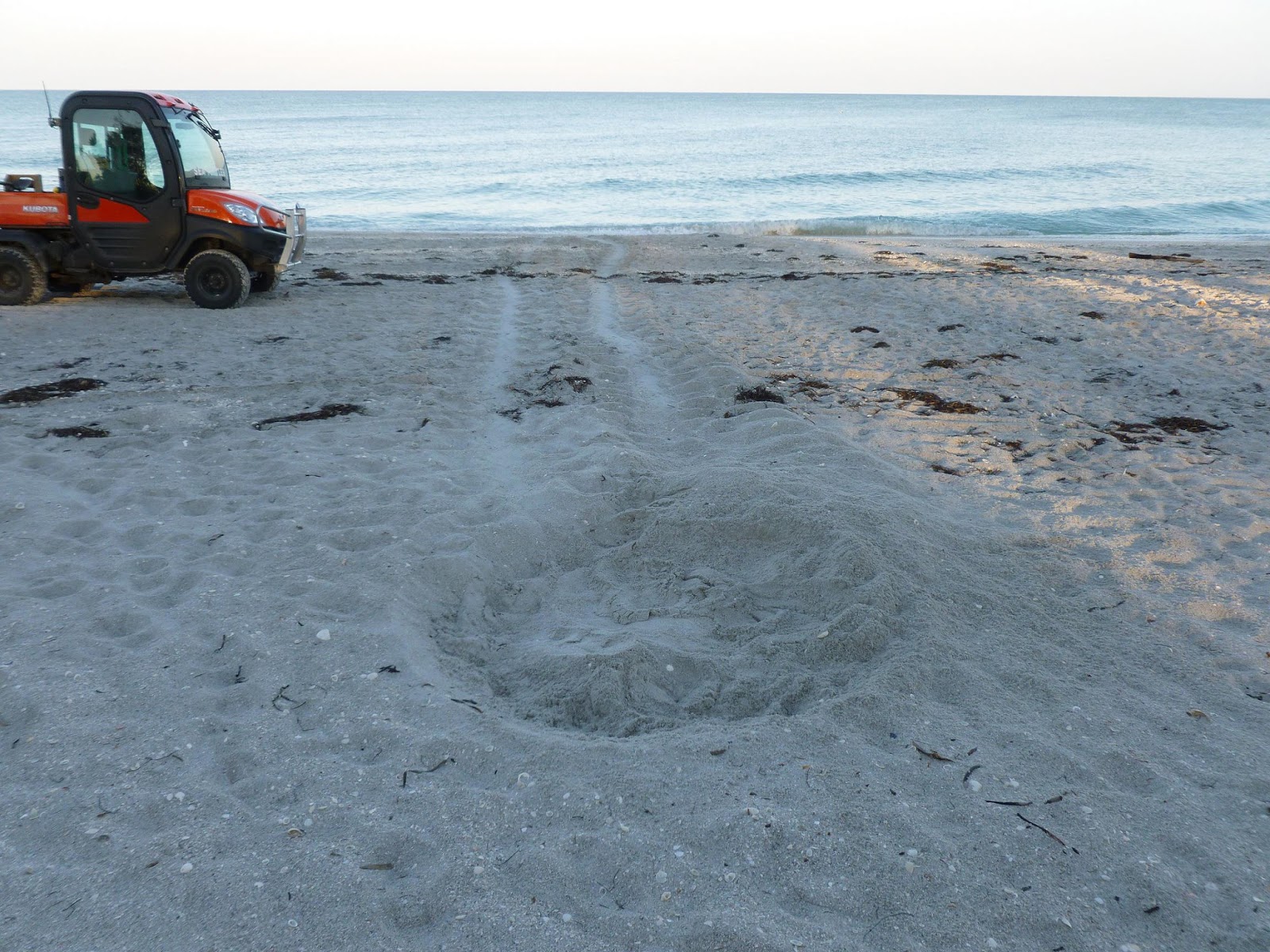


 While May 1 is the official start of sea turtle nesting season in Southwest Florida, sea turtles often follow their own calender. On Friday, April 22 a rare Kemp's Ridley turtle (Lepidochelys kempii) came ashore on Sanibel and gave us our first nest of the season. We didn't quite have the first nest in Lee County, that honor went to Cayo Costa with a Loggerhead nest the night before; we had the most interesting nester. Kemp's Ridleys typically nest during the day, but rarely in Florida. There were only eight nests in the entire state in 2011! Their main nesting ground is Rancho Nuevo, Tamaulipas, Mexico, with additional nesting at Padre Island, Texas. Even though they don't often nest in Florida, this isn't Sanibel's first nest. The last documented Kemp's Ridley nest was in 1996. While they are uncommon on Florida's beaches, they are often found in our waters, which provide important foraging habitat. The Kemp's Ridley is the smallest and rarest sea turtle in the world. They are approximately 100 pounds and measure 2- 2 1/2 feet in length at maturity. They are protected under the U.S. Endangered Species Act where they are listed as endangered.
