June 14, 2013

Nesting Update


We’ve been busy, busy, busy since the last post. We’re now up to 118 nests on Sanibel and 48 nests on Captiva. The nests fared really well through the high tides of Tropical Storm Andrea. 

High surf in front of Island Inn during TS Andrea.
Three nests washed away on Captiva and 15 were washed over by the tide. On Sanibel, we lost 14 nests and 46 nests were washed over. One of the lessons that came out of Tropical Storm Debbie last summer was to not count the nests washed over as a lost cause. Many nests, some that sat underwater for more than a day, still had eggs hatch. This leaves us really hopeful for the nests washed over briefly by Andrea. Luckily, the first green turtle to nest on the islands waited for the storm to pass! 

Sunrise after TS Andrea passed.
Captiva got the first green nest of the season last weekend. Hopefully, there will be many more that follow on both islands.
Green turtle nest on Captiva.


May 17, 2013

Nesting Begins to Pick Up

Nesting activity on Sanibel and Captiva has begun to pick up. There are now seven loggerhead nests on Sanibel and four on Captiva. In addition to monitoring for nesting activity, we also aided in the rescue of a very sick Kemp's ridley turtle this week. Two very kind boaters found it floating and lethargic near Sanibel's lighthouse. We met them at the dock and transported it to CROW for care.

Nest #4 on Captiva before it was staked for protection.

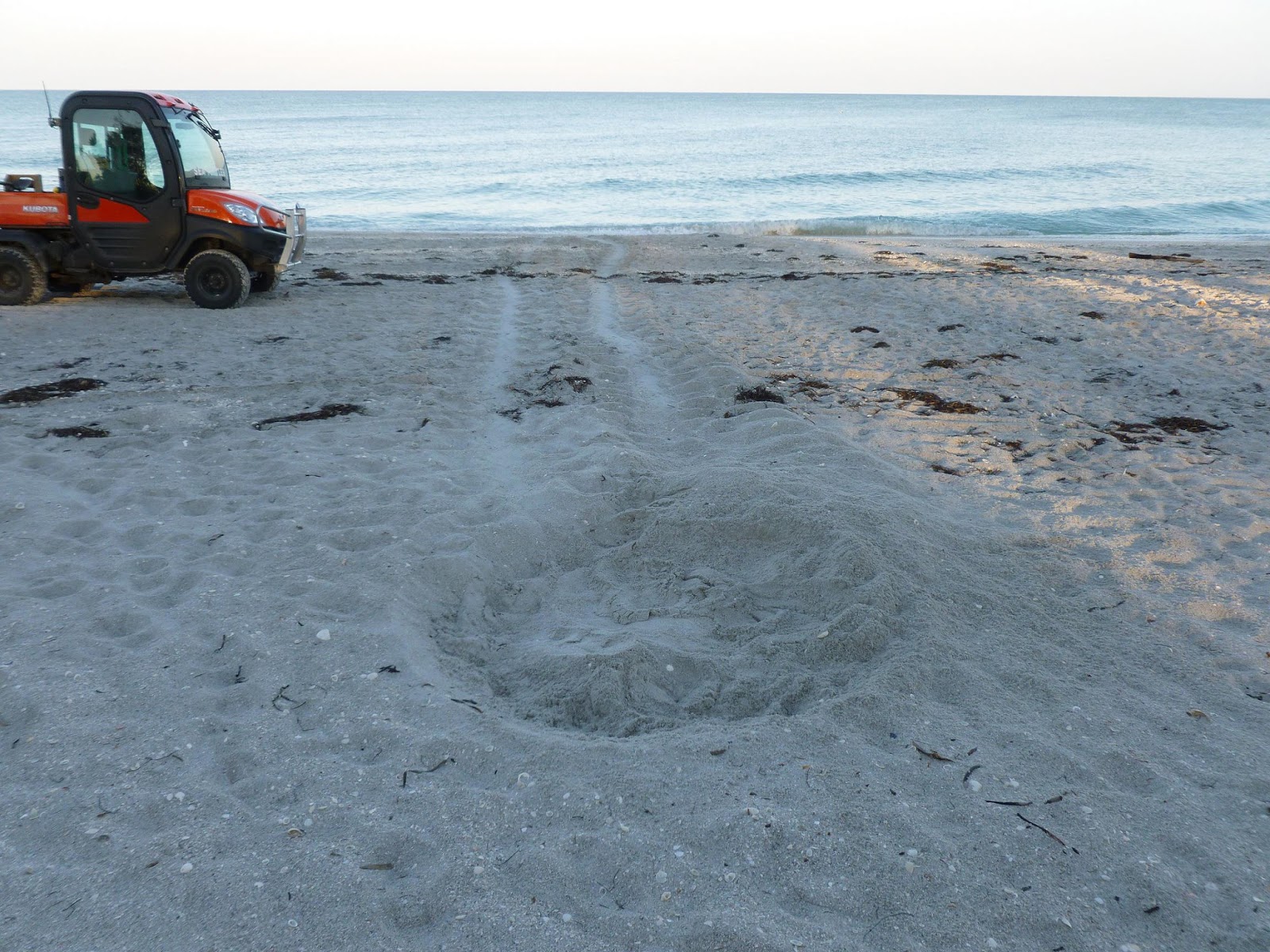
First nest laid east of Tarpon Bay Road on Sanibel.

A very sick Kemp's Ridley being transported to rehab.

May 10, 2013

2013 Nesting Season Underway


We’re off to a nice, slow start to nesting this year, which is quite a contrast from last year’s busy start. The first nest was laid before the official May 1 start to the nesting season on Captiva. Since then, there have been two nests laid on Sanibel

First loggerhead turtle nest on Sanibel Island. Photo by: Julie Reed
Help keep our beaches, and all beaches with nesting sea turtles, turtle-friendly by doing the following during nesting season:

-Shield or turn off any outdoor lighting that faces the beach
-Close curtains or blinds after dark 
-Never take flash photographs of a nesting turtle
-Take all beach furniture, toys, umbrellas, etc. with you when you leave the beach
-Respect all staked nesting areas
-Honor the leash law
-Fill in any holes you dig before you leave the beach
-If you see a nesting turtle, sit quietly at a respectful distance (at least 250ft) and enjoy!

March 20, 2013

Species Spotlight: the Kemp's Ridley Turtle


Meet the Kemp’s ridley turtle (Lepidochelys kempii). The Kemp’s ridley is both the smallest and most endangered of sea turtle species. At maturity, they are 2-2 ½  feet long and around 100 lbs. Their carapace (top shell) is usually almost as wide as it is long, giving it a very round shape. They are found almost exclusively in the Gulf of Mexico. 

Female Kemp's ridley after nesting on Sanibel Island in 2011.
Juveniles use the estuaries on the west coast of Florida as nursery areas. 95% of nesting occurs in Tamaulipas, Mexico along three main beaches. There is also some nesting in Texas and the occasional nest in Florida. Kemp’s ridleys are unique from the other turtles that are found in Florida’s waters in that they often nest during the day. On the beaches of Mexico, the Kemp’s ridley nests in large groups called arribadas.

March 13, 2013

Species Spotlight: the Green Turtle


Green turtle nesting on Sanibel at sunrise. (Photo by: A.Bryant)
Meet the green turtle (Chelonia mydas). As the only vegetarian sea turtle (in adulthood), they eat mostly sea grasses and algae. While not green in color, they are named for the green color of their fat. Green turtles are the largest of the hard-shelled turtles, often reaching over three feet in length and 300-350 pounds. They have an oval-shaped shell and a head that is small in proportion to their body. Hatchlings are typically dark grayish-black with a white underside and white edges to their carapace (top shell) and flippers.

Green turtle hatchling.
Green turtles are found worldwide. The estuaries in Southwest Florida provide nursery habitat for juveniles and our beaches provide nesting habitat. While loggerhead turtle nests make up the bulk of sea turtle nesting in the area, there are several green nests laid each year. Green turtles usually begin nesting in June and continue into September. Like all sea turtles, the green is protected by the U.S. Endangered Species Act. It is currently listed as endangered across its range.


March 5, 2013

Species Spotlight: the Loggerhead Turtle


Sea turtle news is always a bit slower in Southwest Florida this time of year. As we prepare for the upcoming nesting season, it’s a great time to learn a more about the sea turtle species found in Florida’s waters.  Today, meet the loggerhead turtle (Caretta caretta). The loggerhead got its name from its large head, which supports strong jaws used to crush the whelks and conch it eats. They have a reddish brown carapace (top shell) and a pale yellow plastron (bottom shell). Loggerheads are approximately 3 feet long and typically weigh around 250 pounds. 

Rare daytime nesting loggerhead covering her nest. Photo by: A. Bryant
 
The nesting season for loggerhead turtles in Southwest Florida “officially” begins on May 1, although, some females have been known to nest in April. Nesting continues into late August or early September.  Females usually come ashore at night and lay an average of 100 leathery eggs that resemble ping-pong balls. Incubation lasts about two months. Hatchlings are two inches long and emerge at night. They crawl toward the brightest horizon, which is usually the water when there is no artificial lighting present.
Loggerhead turtles are found worldwide. The United States is the second most important nesting ground for this species. Florida is home to 90% of the loggerhead nesting in the U.S.

Loggerhead hatchling. Photo by: J. Jones

All sea turtle species are at risk of extinction. They are protected by the U.S. Endangered Species Act. The population of loggerhead turtles that nest in Southwest Florida are listed as threatened.